
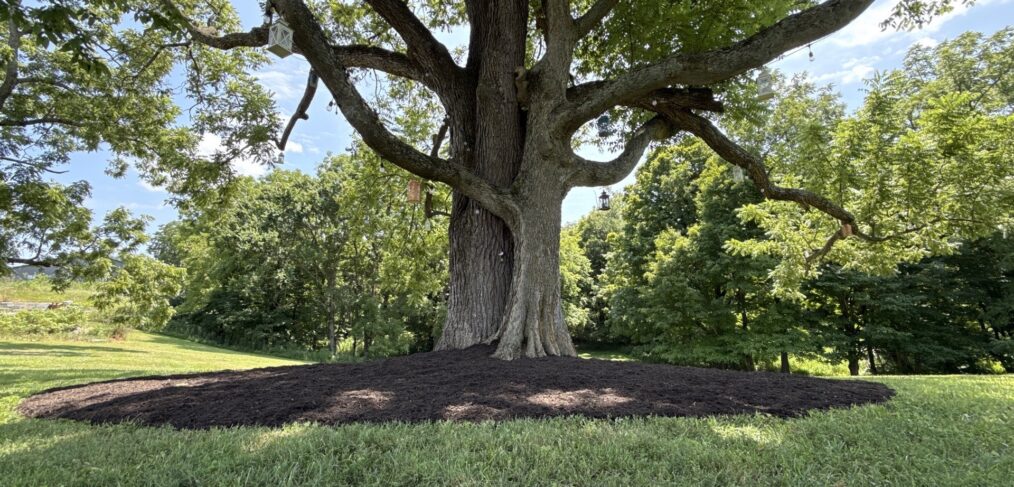
Mature tree with a wide, flat organic mulch ring and visible root flare, mulched for winter

Mulching Trees for Winter: A Practical Guide for Bloomington Homeowners

Mulching trees for winter is one of the simplest, lowest-cost ways to protect them through cold weather. A good layer of organic mulch helps insulate roots, holds moisture in the soil, evens out temperature swings, keeps weeds down, and slowly improves the soil as it breaks down.

Bloomington winters bring plenty of freeze-thaw cycles, and dry falls are not unusual. In those conditions, a properly mulched root zone can make a real difference in how well trees handle winter stress and how strongly they leaf out in spring. The key word is properly. Mulch applied the wrong way can do more harm than good.

This guide covers why mulch matters, how deep and wide to spread it, which materials work best, and the mistakes to avoid.

Why Mulch Matters for Trees in Winter

Tree roots do best in steady conditions. When soil freezes and thaws over and over, shallow roots are exposed to stress, and small, newly planted plants can even be pushed up out of the ground (called frost heaving). A layer of mulch works like insulation, keeping soil temperatures more stable through those swings.

Mulch also helps trees in winter by:

  • Reducing moisture loss from the soil surface
  • Buffering shallow roots against extreme cold
  • Protecting the soil surface from compaction and erosion
  • Limiting competition from weeds and turfgrass
  • Adding organic matter that improves soil structure and fertility over time

Newly planted and young trees benefit the most because their root systems are still developing. Mature trees benefit too, especially when the mulched area is wide.

When to Start Mulching Trees for Winter

Fall is a great time to apply new mulch or refresh an existing ring, ideally before the ground freezes. That gives the mulch time to settle and start moderating soil temperatures heading into winter.

If you mulched in spring or summer, check the depth this fall. Organic mulch breaks down over the growing season, so it may need a light top-up. If the soil is dry, water the root zone before you mulch. The mulch will help hold that moisture in. Our guide to watering trees before winter covers when and how much to water.

How Deep and How Wide Should Mulch Be?

Depth: 2 to 4 Inches

  • Less than 2 inches doesn’t do much for moisture or temperature.
  • More than 4 inches can limit the oxygen and water reaching the roots and keep the soil too wet.

Coarser materials like wood chips can sit at the deeper end of that range. Finer materials should stay closer to 2 inches.

Width: Go Wide, Not Deep

Spread mulch as far toward the drip line (the outer edge of the branches) as is practical. For young trees, even a ring 3 to 6 feet across helps. For larger trees, a wide ring does far more good than a small circle at the base.

Keep It Off the Trunk

This is the most important rule. Leave a gap of at least 1 to 2 inches between the trunk and the start of the mulch, and a little more around large trees. The root flare, where the trunk widens as it meets the roots, should always be visible. Mulch piled against bark holds moisture against the trunk, which can lead to decay, attract bark-chewing rodents, and encourage roots to grow up into the mulch and circle the tree.

Best Mulch Materials for Trees

Organic mulches are the clear choice for trees. They conserve moisture, moderate soil temperature, and feed the soil as they break down. Inorganic options like rock or rubber do none of the last part.

Arborist Wood Chips and Whole-Tree Mulch

Mulch made from whole trees, including both woody material and leaves, is widely considered the best option for tree health. It holds moisture, moderates temperature, and suppresses weeds well, and the mix of materials breaks down gradually to support soil life and structure. Coarser natural wood chips are a great fit for established trees, large mulch rings, and naturalized areas because water passes through them easily.

At Bluestone Tree, we recycle local tree material into organic mulch products, including our Premium Whole Tree Mulch and wood chips. Using local material keeps it in the community and returns organic matter to the soil it came from.

Shredded Leaves

If you have mature trees and a yard full of fall leaves, shredded leaves make a practical, free mulch. Run them over with a mower first. Whole leaves in thick layers tend to mat together and block water and air.

Materials to Use Carefully or Avoid

  • Fresh grass clippings: mat down and restrict air and water movement
  • Thick layers of whole leaves: form a dense, soggy mat
  • Fine sawdust in thick layers: compacts and sheds water
  • Rubber or rock: add no organic matter to the soil
  • Sour-smelling mulch: mulch that has sat in a large, wet pile can ferment. If it smells sour or feels hot, spread it out to air before using it near plants.

How to Mulch a Tree Step by Step

  1. Clear grass, weeds, and debris from the area you plan to mulch.
  2. Water the root zone if the soil is dry, which is especially important in fall.
  3. Spread mulch in an even layer 2 to 4 inches deep.
  4. Pull mulch back from the trunk so no mulch touches the bark and the root flare stays visible.
  5. Shape a wide, flat ring (think doughnut, not volcano).
  6. Check it once or twice a year and top up only as needed to keep the right depth.

Fixing a Mulch Volcano

If mulch has been piled against a trunk, gently pull the excess away and spread it outward into a flat ring until the root flare is exposed. If the flare has been buried under soil or years of built-up material, an arborist can evaluate the root collar for girdling roots or bark damage before you dig.

Newly Planted vs. Established Trees

Newly planted trees: A proper mulch ring is one of the most helpful things you can give a new tree. It reduces transplant stress, holds moisture, and steadies soil temperatures during the first few winters. Mulch beyond the root ball to encourage roots to spread outward.

Established trees: Keep the ring maintained, and consider widening it over time. A larger mulched area means less competition from turf and a healthier root zone.

Common Mulching Mistakes to Avoid

  • Volcano mulching: piling mulch high against the trunk. It is common and one of the most harmful mistakes.
  • Spreading mulch deeper than about 4 inches
  • Burying the root flare
  • Using sour-smelling mulch straight from a large pile
  • Letting whole leaves form a dense mat
  • Adding new mulch every year without checking the depth already there
  • Piling mulch against house foundations or siding where it holds moisture against the structure

The good news is that most of these are easy to fix with a rake and a little time.

How Mulch Fits Into Your Winter Tree Care Plan

Mulch works best as part of a simple fall routine:

  • Deep watering when the soil is dry, before the ground freezes
  • Trunk protection for young or thin-barked trees
  • Removing dead or hazardous branches through proper pruning
  • Checking soil moisture during winter thaws

When to Call a Bloomington Arborist

Most homeowners can mulch their own trees. Consider calling an arborist if:

  • Trees are already showing stress, thinning, or decline
  • Mulch has been piled against trunks for years and you’re worried about root collar problems
  • You’re caring for many trees or high-value specimens
  • You want mulching built into a bigger plant health care plan that includes pruning and a look at tree structure

Take a Quick Walk Around Your Trees This Fall

Mulching trees for winter is one of the highest-value, lowest-cost things you can do for your landscape. Look at the base of each tree. If you see bare soil, a thin layer, or mulch piled against the trunk, a few minutes with a rake and a fresh 2 to 4 inch ring can set your trees up for a healthier spring.

Need mulch, or want an arborist to look at your trees? Call Bluestone Tree at 812.824.3335, browse our mulch products, or request an estimate.

Sources: Purdue Landscape Report, Re-mulch Your Trees; Purdue Landscape Report, Simple Steps to Care for Your Tree: Mulching; Penn State Extension, Proper Mulching; University of Missouri Extension, Sour Mulch.
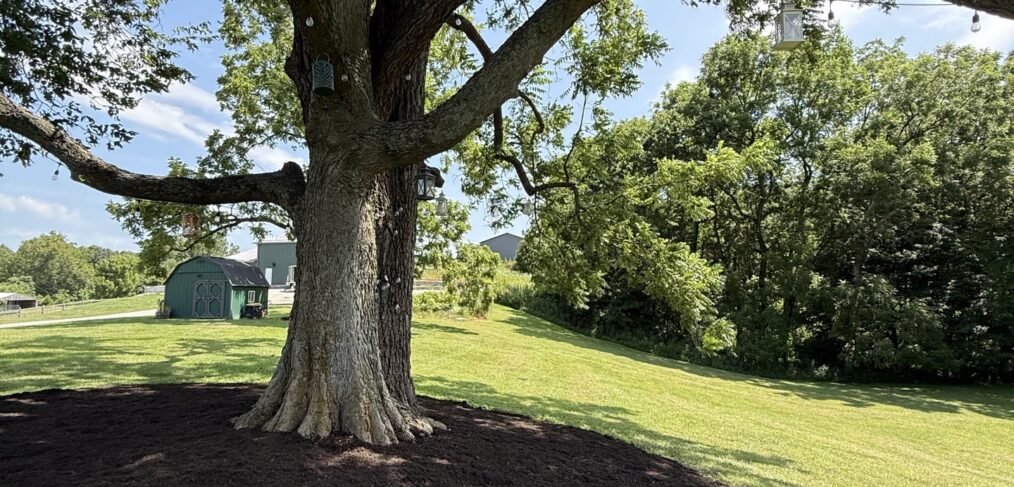
Soaker hose watering a young evergreen tree with a mulch ring before winter in Bloomington, Indiana

Watering Trees Before Winter: A Practical Guide for Bloomington Homeowners

Watering trees before winter is one of the simplest ways to protect them, and one of the steps homeowners skip most often. Once leaves drop and the air turns cool, it is easy to assume your trees are done needing water for the year. They are not. Roots keep taking up moisture until the soil freezes, and trees keep losing water through their buds, twigs, and (for evergreens) needles all winter long.

When a tree heads into winter with dry soil, it has little chance to make up the difference until spring. That raises the risk of winter burn, twig dieback, and a slow start next season. In Bloomington and across South Central Indiana, dry autumns, heavy or compacted soils, and repeated freeze-thaw cycles make this worth paying attention to.

This guide covers why fall and early-winter watering matters, when to do it, how much water to give, and which trees on your property need it most.

Why Trees Still Need Water After the Leaves Fall

Deciduous trees go dormant in fall, but dormant does not mean drought-proof. According to Purdue Extension, woody plants keep losing water through winter, and evergreens lose even more because they hold onto their foliage. Sunny, windy days speed that loss up.

The trouble starts when the ground freezes. Frozen soil cuts off the roots’ water supply, so the tree can’t replace what it is losing. Trees that start winter with good soil moisture are much better equipped to ride out those stretches.

What Raises the Risk in South Central Indiana

  • Dry falls. Dry spells that stretch into autumn are not unusual in Indiana, and a few fall showers often aren’t enough to recharge the root zone.
  • Wind and dry air. Winter wind pulls moisture from twigs, buds, and evergreen foliage.
  • Young root systems. Newly planted and young trees have less soil to draw water from.
  • Heavy or compacted soil. Clay-rich or compacted soils absorb water slowly, so rain can run off before it soaks in.
  • Freeze-thaw cycles. The soil may lock up and reopen several times in a single winter.

When to Start Watering Trees Before Winter in Bloomington

Watch soil moisture, not just the calendar. In most years, the main window runs from mid-October through November and sometimes into early December, depending on when the ground freezes. The rule is simple: when rainfall falls short, keep watering through fall until the ground is frozen.

Watering During Winter Thaws

Southern Indiana winters often bring mild spells. If the soil has thawed, it has been dry, and the air temperature is above about 40°F, a winter watering can help evergreens and young trees. Water in the morning or around midday so it has time to soak in before temperatures drop at night.

When Not to Water

  • The ground is frozen. Water can’t reach the roots and just sits on the surface or runs off.
  • The soil is already wet. Saturated soil can damage roots, especially on heavy ground.
  • It has rained enough recently. Check the soil first. Don’t water on a schedule just to water.

How Much Water Do Trees Need Before Winter?

When watering trees before winter, deep and occasional beats frequent and light. A quick spray from the hose wets the surface but rarely reaches the roots that matter.

  • Aim for depth. Water slowly until the soil is moist about 12 inches down, where most of a tree’s water-absorbing roots are.
  • Use a simple baseline. During a dry fall, a thorough watering every 7 to 10 days is a good starting point. Adjust it for rainfall and what your soil check shows.
  • Water the right area. Most absorbing roots sit under the drip line of the canopy and beyond, not tight against the trunk. Spread water across that whole area.
  • Give evergreens extra attention. Evergreens benefit from slow, deep watering once or twice a week until the soil freezes.
  • Don’t overdo it. The goal is soil that is evenly damp, not soaked.

How to Check Soil Moisture

Push a long screwdriver or soil probe into the ground under the canopy, or dig a small hole a few inches deep with a trowel. If the soil is dry and hard to push into several inches down, it’s time to water. If it’s moist, wait a few days and check again.

Newly Planted Trees

Newly planted trees need the most help because their roots haven’t spread far beyond the original planting area. A common rule of thumb is that a tree takes about one growing season to establish for every inch of trunk diameter, so a 2-inch tree may need extra care for two years or more. Focus water on the root ball and just beyond it, and check these trees more often than your established ones.

Best Ways to Water Trees in Fall and Winter

Slow application is the key, especially on heavy or compacted soil where fast water simply runs off.

  • Soaker hoses or drip lines laid in loops across the root zone
  • A garden hose on a slow trickle, moved to a new spot every so often
  • Watering bags or slow-release rings for young trees
  • Several shorter sessions if your soil absorbs water slowly

Skip overhead sprinklers in cold weather. They wet leaves and needles without delivering much water to the roots. Also avoid soaking trunks and foliage late in the day when a hard freeze is coming.

Which Trees Need the Most Attention?

If you can’t water everything, prioritize these:

  • Newly planted trees, especially those planted in the last one to three years
  • Young trees still building their root systems
  • Evergreens such as spruce, pine, fir, and arborvitae
  • Broadleaf evergreens such as holly, which lose water through their leaves all winter
  • Trees in compacted or restricted soil near driveways, sidewalks, and foundations
  • Trees on dry slopes, ridges, or windy sites
  • Trees that showed drought stress over the summer

Mature shade trees in good soil usually need less help. After a long dry stretch in fall, though, a deep soak across the root zone can benefit them too.

Pair Fall Watering With Mulch

Mulch and water work as a team. A 2 to 4 inch layer of organic mulch over the root zone slows evaporation, evens out soil temperature swings, and helps hold moisture through freeze-thaw cycles.

  • Keep mulch a few inches away from the trunk so the root flare stays visible.
  • Spread it wide, ideally out toward the drip line, instead of piling it high.
  • Never build a mulch “volcano” against the trunk.

At Bluestone Tree, we make organic mulch from local tree material, and it is a good fit for winter root-zone protection.

Common Fall Watering Mistakes to Avoid

  • Assuming fall rain has been enough without checking the soil
  • Waiting until the ground has already frozen
  • Watering only at the base of the trunk
  • Applying water so fast that it runs off
  • Watering soil that is already saturated
  • Forgetting about evergreens and newly planted trees
  • Using overhead sprinklers in cold weather

Signs Your Trees Needed More Water Last Winter

Winter moisture stress often doesn’t show up until spring. Watch for:

  • Brown needle tips, or fully browned needles, on pines, spruces, and other conifers (winter burn)
  • Brown, curled leaf edges or reddish-purple discoloration on broadleaf evergreens
  • Dieback at the tips of branches
  • Slow, sparse, or uneven leaf-out

These symptoms can point to winter moisture stress, but they can also come from cold injury, road salt, pests, disease, or root problems. Before assuming the cause, have the tree looked at. It also helps to wait until spring growth shows the full extent of the damage before pruning affected branches. For more on what to look for, see our guide to signs of a dying tree.

When to Call a Bloomington Arborist

Most homeowners can handle fall watering with a hose, a soaker line, or a few watering bags. It makes sense to bring in an arborist when:

  • You have many large or high-value trees to look after
  • Slopes, access, or soil conditions make thorough watering difficult
  • Trees are already showing stress, thinning, or dieback
  • You want watering advice as part of a bigger look at tree health, pruning, and mulching

Our plant health care services are built for exactly this kind of year-round support, from soil and moisture issues to pests and disease.

Give Your Trees a Better Start on Spring

Watering trees before winter takes little more than a hose, a quick soil check, and attention to the forecast. Start with your newest trees and your evergreens, water deeply and slowly when the soil is dry, stop once the ground freezes, and add a layer of mulch to hold that moisture in.

Not sure what your trees need this season? Call Bluestone Tree at 812.824.3335 or request an estimate, and our team can help you build a plan for the trees on your property.

Sources: Purdue Extension, Water Now to Minimize Winter Injury; Purdue Extension, Winterize Your Trees (FNR-484-W); Purdue Landscape Report, Autumn Tree Care.

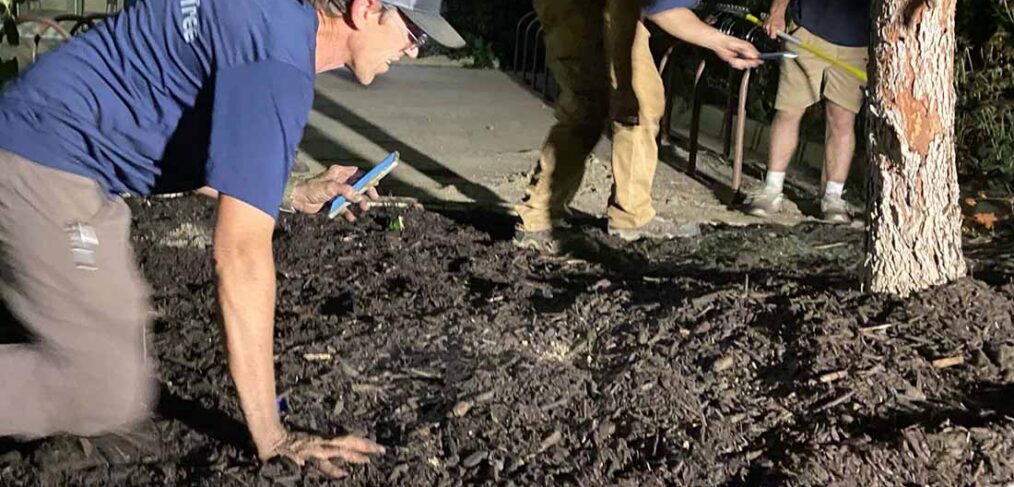
Bluestone Tree arborist spreading wood chip mulch around a young tree in Bloomington, Indiana before winter

How to Winterize Trees in Bloomington, Indiana: A Homeowner’s Guide

Winter in South Central Indiana is hard on trees. Freeze-thaw cycles, drying winds, ice storms, and sudden temperature swings are all part of a normal Bloomington winter, and trees that head into the cold season dry or stressed are more likely to show winter burn, frost cracks, broken limbs, or a slow start in spring. The good news is that the winter tree care Bloomington homeowners do in late fall makes a real difference, and most of it is simple.

In this guide, our arborists walk through the steps we recommend for trees across Bloomington, Monroe County, Ellettsville, Bedford, and Martinsville. The advice follows Purdue Extension’s winter tree care recommendations and standard arboriculture practice. Most of the work is homeowner-friendly. Large trees, high limbs, and anything near your house or power lines are where a professional should step in.

Why Winter Prep Matters for Indiana Trees

Most of the Bloomington area sits in Zone 6b on the 2023 USDA Plant Hardiness Zone Map, with parts of the region to the north closer to 6a. Milder averages don’t make winter easy on trees, though. Local trees regularly deal with:

  • Soil that freezes for stretches of winter, cutting roots off from water
  • Dry air and wind that pull moisture from evergreen needles and leaves
  • Ice and wet snow that load weak or overextended branches
  • Sunny days followed by hard freezes, which can cause sunscald and frost cracks on thin bark

Young trees, newly planted trees, evergreens, and thin-barked species such as maples, lindens, honey locusts, and crabapples are the most vulnerable. Mature, healthy shade trees are more resilient, but they still benefit from a pre-winter check, especially for dead or weak limbs.

Step 1: Inspect Your Trees Before Winter Storms

Walk your property as the leaves come down and look closely at each tree. Start with the trees nearest your house, driveway, and the areas your family uses most. Look for:

  • Dead, broken, or hanging branches
  • Cracks in the trunk or major limbs
  • Branches rubbing against the roof, siding, power lines, or each other
  • Leaning trunks or cracked, heaving soil at the base
  • Weak branch attachments, such as tight V-shaped forks
  • Mushrooms at the base, missing bark, or other signs of a dying or diseased tree

Small deadwood you can safely reach from the ground is fine to remove yourself. For anything high, heavy, or near structures, schedule a professional tree risk assessment. Late fall and winter are good times for this because a bare canopy makes structural problems much easier to see.

Step 2: Water Deeply Before the Ground Freezes

Late-fall watering is one of the most overlooked steps in winterizing trees. Roots keep absorbing water after the leaves drop, as long as the soil isn’t frozen. If a dry fall sends trees into winter short on moisture, evergreens and young trees in particular can dry out and show the damage in spring.

How Much to Water

  • Water when rainfall has been light, and keep going through fall until the ground freezes.
  • For young or newly planted trees, Purdue Extension’s “5 + 5 rule” is a good starting point: about 5 gallons of water plus 5 more gallons for every inch of trunk diameter.
  • For established trees, Purdue suggests about 1 inch of supplemental water per week over the root zone during dry stretches.
  • Apply water slowly with a soaker hose or slow trickle so it soaks in instead of running off.
  • Cover the whole root zone, from near the trunk out to and past the drip line (the outer edge of the canopy).

Watering During Winter Thaws

If winter turns dry and the ground thaws, water on a mild day when temperatures are above 40°F, early enough that the water soaks in before nightfall. The goal is moist soil, not waterlogged soil, so go easy on poorly drained sites.

Step 3: Refresh Mulch Around the Root Zone

Mulch is one of the highest-value, lowest-effort winter protections you can give a tree. It evens out soil temperature swings, holds moisture, and reduces competition from turf.

  • Spread 2 to 3 inches of organic mulch such as wood chips, shredded bark, or composted leaves.
  • Extend it toward the drip line as far as practical. A wide, flat ring works far better than a small pile.
  • Keep mulch a few inches away from the trunk so the root flare stays visible. Mulch piled against bark (“volcano mulching”) holds moisture against the trunk and invites decay, insects, and rodents.
  • Top up mulch that broke down over the growing season.

Step 4: Protect Young and Thin-Barked Trunks

On sunny winter days, the south and southwest side of a trunk can warm well above the air temperature, then refreeze quickly once the sun drops. That swing can damage living tissue under thin bark and lead to sunscald (sometimes called southwest injury) or frost cracks. Those wounds give decay organisms a way in.

Trunk Wrap

  • Use a flexible, light-colored tree wrap or guard made for winter trunk protection.
  • Cover the trunk from the base up to about the first branches.
  • Install it in late fall, and remove it in spring after the last hard freeze. Wraps left on year-round can trap moisture and shelter insects.
  • Focus on young trees and smooth or thin-barked species such as maples, lindens, honey locusts, and crabapples.

White Latex Paint (Mostly for Fruit Trees)

Some extension services recommend painting the trunks of young fruit trees with diluted white interior latex paint to reflect sunlight. It’s a common orchard practice, but it isn’t necessary for most landscape trees. Never use oil-based paint on a tree.

Burlap Screens for Exposed Evergreens

Evergreens in windy, exposed spots can benefit from a burlap screen on stakes along the windward side. Keep the burlap off the foliage so air can still circulate.

Step 5: Handle Structural and Safety Issues Before Ice Season

Snow and ice can turn weak limbs into hazards quickly. Before winter weather arrives, prioritize:

  • Removing dead or dying limbs, especially over roofs, driveways, walkways, and play areas
  • Reducing long, heavy limbs where appropriate to improve stability
  • Evaluating co-dominant stems and weak branch unions, which may need structural pruning or support

If a limb or whole tree already looks unstable, don’t wait for the first storm. Our hazardous tree removal guide covers the warning signs in more detail.

Pruning Timing in Fall and Winter

Late fall and early winter are fine for limited, functional pruning, such as removing dead, diseased, or broken branches. Heavier structural tree pruning on most deciduous trees is usually best in late winter, while trees are still dormant and just before spring growth. Avoid heavy pruning in early fall, particularly on stressed trees. Hazardous limbs should be addressed as soon as practical, whatever the season.

Oaks Need Special Timing Because of Oak Wilt

According to Purdue, oak wilt has been found in most Indiana counties, and trees in the red and black oak group are especially vulnerable. The fungus spreads overland mainly through sap beetles drawn to fresh wounds in spring and early summer, so regional forestry agencies advise against pruning or wounding oaks from roughly April through July. That makes the dormant season the right time to prune oaks. If an oak is damaged or has to be cut during the risk window for safety reasons, talk to an arborist about protecting the wound.

Step 6: Give Evergreens Extra Attention

Evergreens keep losing moisture through their needles and leaves all winter. When the soil is frozen or dry and the wind picks up, they can’t replace that water, and the result is browned foliage known as winter burn. Arborvitae, boxwood, holly, and white pine are common examples.

  • Water evergreens well through fall until the ground freezes. This is the most reliable protection.
  • Screen plants in exposed, windy spots with burlap on the windward side.
  • Anti-desiccant sprays may help some broadleaf evergreens, but research results are mixed, and they are not a substitute for watering. If you use one, follow the label closely on timing and reapplication.
  • Skip high-nitrogen fertilizer late in the season, since it can push tender new growth that cold easily damages.

A Note on Fall Fertilizer

Fall fertilizing isn’t automatically off-limits. Purdue Extension notes that a low-nitrogen fertilizer can be applied in fall to trees that aren’t drought-stressed. Whether your trees actually need it depends on soil and tree condition, which is exactly what a plant health care visit or soil test can tell you.

A Winter Tree Care Calendar for Bloomington

  • September to October: Start inspections, keep up with leaves, and watch soil moisture during dry spells.
  • Late October to November: Deep watering as needed, mulching, trunk wraps on young and thin-barked trees, and light corrective pruning.
  • December to February: Check trees after storms, water during dry thaws above 40°F, and schedule dormant-season pruning, including oaks. If a storm brings down a limb on your house or driveway, call for emergency tree service.
  • Late winter to early March: A good window for structural pruning of many deciduous trees before buds break.
  • Spring, after the last hard freeze: Remove trunk wraps.

Timing shifts a little every year with the weather. What matters most is finishing the core prep before prolonged freezing sets in.

Common Winter Tree Care Mistakes to Avoid

  • Letting soil go into winter bone-dry
  • Piling mulch against the trunk
  • Leaving dead or weakly attached branches over the house or driveway
  • Heavy pruning in early fall
  • Pruning oaks in spring or early summer
  • Leaving trunk wraps on all year
  • Ignoring young or newly planted trees
  • Assuming mature trees need no attention

Winter Tree Care Bloomington Homeowners Can Handle vs. When to Call an Arborist

Homeowners can usually handle watering, mulching, trunk wraps, and small pruning cuts made safely from the ground. Call a qualified arborist when:

  • Branches are large, high, or hanging over structures
  • You see cracks, decay, fungal growth, or signs of disease
  • Several trees need evaluation before storm season
  • An oak needs pruning or has been wounded
  • You want a formal tree risk assessment or a dormant-season pruning plan

Branches touching or near power lines should only be handled by your utility or qualified line-clearance professionals. Never attempt that work yourself.

Get Your Trees Ready Before the First Ice Storm

Winterizing trees isn’t complicated, but it’s seasonal and easy to put off. A few focused hours this fall spent inspecting, watering, mulching, and protecting vulnerable trunks helps your trees come through winter healthier and reduces the chance of storm breakage. Start with the trees closest to your home and the spaces people use most, then work outward.

If you have mature trees, a larger property, or a specific tree you’re unsure about, our arborists can take a look and help you prioritize what needs attention before winter and what can wait until spring. Call Bluestone Tree at 812.824.3335 or request a free estimate. We serve Bloomington, Monroe County, Ellettsville, Bedford, Martinsville, and the surrounding South Central Indiana area.

Further Reading