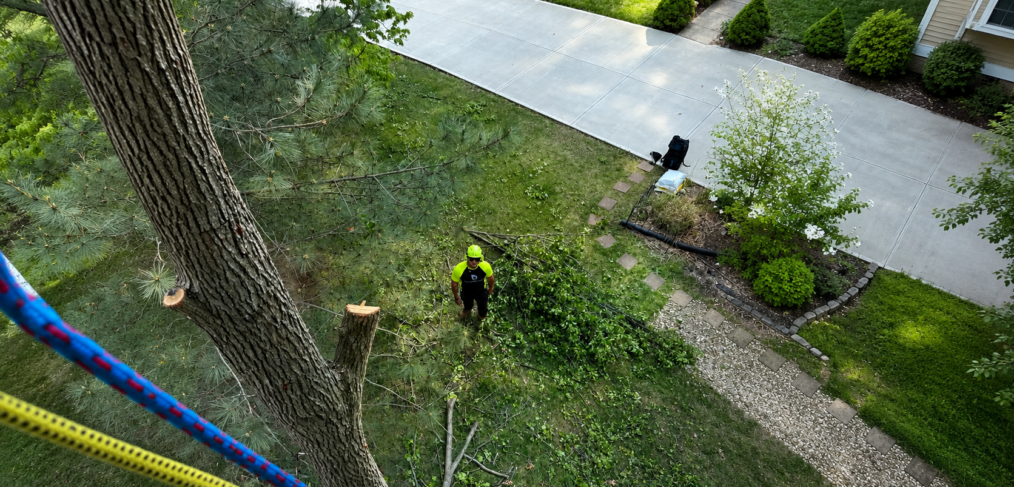
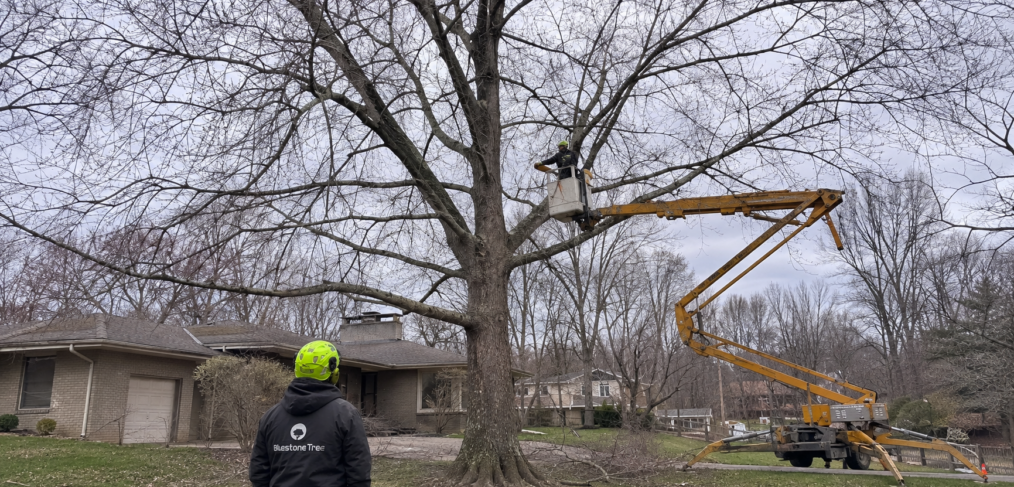
Silver maple pruning Bloomington homeowners schedule before storm season — rather than after — is one of the most cost-effective things you can do for a mature yard tree. Silver maple (Acer saccharinum) grows fast, shades a new lot within a few years, and shows up in yards throughout Bloomington and Monroe County. It also has soft wood, weak branch attachments, and a well-earned reputation for shedding heavy limbs in summer thunderstorms and ice events. This guide covers when to prune, how to make correct cuts, and where the line sits between safe DIY work and a job that belongs to a trained crew.
Why Silver Maples Fail in South Central Indiana Storms
Homeowners planted silver maples for good reasons: rapid growth, the flash of silver leaf undersides in a breeze, and quick shade on a bare lot. The trade-offs show up later.
The structural problems built into the species
- Soft, low-density wood that breaks under load more readily than oak or hickory.
- Weak branch unions — narrow V-shaped attachments, often with included bark trapped between the stems.
- Co-dominant stems, where two leaders of similar size compete and neither develops a strong attachment.
- Dense canopies with accumulating deadwood when pruning is deferred for years.
- Long, end-heavy limbs that act like levers in high wind.
Put those traits in a climate that delivers regular summer thunderstorms, straight-line winds, and periodic ice, and you get the trees most likely to land on a roof, a car, a fence, or a power line.
What deferred pruning actually costs
Waiting until after a storm changes the math. The damage is already done, emergency response costs more than scheduled work, and the options for saving the tree narrow considerably. Torn limbs leave ragged wounds that decay faster than clean cuts. Shallow silver maple roots already compete with turf and can lift sidewalks; when soils are saturated and the root system is compromised, whole-tree failure becomes a real possibility rather than a remote one.
Improper DIY work makes it worse. Topping a silver maple — cutting the crown back to stubs — triggers a flush of weak, upright water sprouts attached to decaying stubs. Those sprouts fail sooner and more dramatically than the limbs they replaced.
Best Time for Silver Maple Pruning in Bloomington and Monroe County
Timing advice for maples has shifted. Rather than defending one narrow seasonal window, current practice weighs the tree’s condition, the pruning objective, soil moisture, and weather.
- Dead, broken, cracked, or hanging limbs: address whenever they’re found. Safety doesn’t wait for a season.
- Structural and routine pruning: can generally be done through much of the year when conditions are appropriate. Dormant-season work offers the clearest view of branch architecture once leaves drop.
- Avoid significant pruning during drought, extreme heat, extreme cold, or when the tree is already stressed by pests, disease, or recent root disturbance.
If you’re unsure whether your tree is under stress, a plant health care evaluation before pruning is worth the visit. Pruning a declining tree on the wrong schedule compounds the decline.
Tools and Safety Gear for Pruning a Silver Maple
- Sharp bypass hand pruners, loppers, and a pruning saw — dull tools crush and tear rather than cut.
- Clean tools, disinfected between trees when disease transmission is a concern.
- Helmet, eye protection, gloves, and sturdy non-slip footwear.
- A pole pruner for small branches you can reach safely with both feet on the ground.
Do not climb a silver maple without training. The wood is brittle, the canopy is dense, and limbs that look sound from below regularly aren’t. Anything near power lines, anything over a structure, and anything requiring a ladder or a saddle belongs to a trained crew with the right equipment and insurance.
How to Prune a Silver Maple: Step by Step
1. Assess the whole tree before you cut anything
Walk the full circle of the tree and look up. You’re looking for dead or hanging branches, cracks, narrow V-shaped unions, co-dominant stems, crossing or rubbing limbs, and limbs that are large relative to the trunk — as a general guide, major limbs should be well under half the diameter of the stem they attach to. Note what sits underneath: the house, the garage, the driveway, the sidewalk, the play set, the service drop. In older Bloomington neighborhoods, mature silver maples often sit close to all of them.
2. Make safety and health cuts first
Remove dead, dying, diseased, and broken branches before you touch anything living and healthy. Cut back to healthy wood just outside the branch collar — the swollen ring where the branch joins the trunk or a larger limb. Don’t leave stubs, and don’t cut flush into the collar. The collar contains the tissue the tree uses to seal the wound; damaging it invites decay into the trunk.
3. Use the three-cut method on larger limbs
- Undercut: a short distance out from the collar, cut about one-third of the way up through the underside of the branch.
- Top cut: a few inches farther out, cut down through the branch. The weight drops away cleanly instead of peeling bark down the trunk.
- Final cut: remove the remaining stub with a clean cut just outside the branch collar.
Skipping the undercut on a silver maple is how homeowners end up with a three-foot bark tear running down the trunk. The species’ bark strips easily, and that wound will outlast the reason you made the cut. The International Society of Arboriculture’s guidance on pruning mature trees covers cut placement in more detail.
4. Improve structure and reduce end weight
- On younger trees, identify and maintain a single dominant central leader.
- Subordinate or remove competing leaders and branches with narrow, weak attachment angles.
- Reduce end weight on long, heavy limbs by cutting back to a strong lateral branch — ideally one at least a third the diameter of the limb being shortened.
- Thin selectively where it improves structure, while keeping enough interior foliage and the tree’s natural form intact. Stripping the interior and leaving foliage only at the branch tips (“lion-tailing”) increases failure risk rather than reducing it.
- Raise the canopy for clearance over walks, drives, and roofs gradually — over several seasons if the clearance needed is significant.
5. Don’t over-prune
A widely used rule of thumb is to remove no more than roughly a quarter of the live canopy in a single season, and less than that on mature or stressed trees. Silver maples respond to heavy live-wood removal with a flush of weak water sprouts and, often, visible decline. When in doubt, take less and come back next year.
6. Clean up completely
Rake and remove all debris, including small material that hides trip hazards and holds moisture against the trunk flare. If you’re having work done professionally, confirm in advance how woody debris will be handled — some of it can be processed into organic mulch rather than hauled to a landfill.
Silver Maple Pruning Bloomington Homeowners Can Safely Do Themselves
The honest boundary is narrower than most people expect. DIY territory is:
- Small-diameter branches you can reach with both feet flat on the ground.
- Suckers and water sprouts at the base or along lower limbs.
- Light clearance pruning well away from structures and utility lines.
- Removing an obviously dead small branch that’s already hanging low.
Everything else — anything overhead, anything requiring a ladder, anything within reach of a power line, and any limb heavy enough that you can’t control where it lands — is professional work. That’s not upselling; it’s the difference between a pruning cut and an ER visit.
When to Call a Certified Arborist
Bring in an ISA Certified Arborist when your silver maple has large limbs over a structure, visible cracks or cavities, a noticeable lean, fungal conks at the base, or a history of limb failure. A qualified arborist can perform a risk assessment that accounts for the tree’s condition and what sits beneath it, then recommend pruning, cabling, monitoring, or removal based on evidence rather than guesswork.
After significant storms move through Monroe County, a post-storm walkthrough is worthwhile even if nothing came down. Cracked limbs and partially failed unions often hold until the next wind event. If something has already failed, emergency tree service and storm cleanup crews can stabilize the situation before secondary damage occurs.
Street trees and city right-of-way
If your silver maple sits in the tree lawn between the sidewalk and the curb, it may fall under city jurisdiction rather than yours. Check with the City of Bloomington before pruning or removing a street tree, since permit requirements and approved practices differ from private-property work.
When Pruning Isn’t the Right Answer
Sometimes the correct recommendation is that the tree has passed the point where pruning fixes anything. Extensive internal decay, large trunk cavities, severe lean with soil heaving at the root plate, or several major defects positioned directly over a house all point toward tree removal and replanting with a stronger, better-suited species.
That’s a harder conversation than a pruning quote, but it’s the one worth having. A replacement tree planted this year is a decade closer to shade than one planted after a failure. If the concern is pest or disease pressure rather than structure — silver maples are susceptible to a range of issues worth identifying correctly — tree pest and disease care starts with an accurate diagnosis. The Indiana DNR Division of Forestry maintains current information on pests affecting Indiana hardwoods.
Schedule a Silver Maple Assessment in Bloomington
Regular, correctly timed pruning keeps a silver maple an asset instead of a liability. It reduces storm risk, improves structure, extends the useful life of the tree, and costs meaningfully less than emergency work and roof repair.
If your silver maple has limbs over the house, hasn’t been looked at in years, or came through the last storm looking different than it did before, have it evaluated. Bluestone Tree provides tree trimming and pruning throughout Bloomington, Ellettsville, Bedford, Martinsville, and the surrounding South Central Indiana communities. Call 812.824.3335 or request an estimate to get a straightforward assessment of what your tree needs — and what it doesn’t.
This guide reflects general arboricultural best practices for the Midwest. Individual trees vary, and any work involving large limbs, elevated positions, or potential hazards warrants an on-site professional evaluation.