Few parts of owning a home in Monroe County feel worse than realizing a favorite tree has to come down. Diseased tree removal Bloomington homeowners face is almost never a purely practical decision — there is usually guilt attached to it. Maybe it is the silver maple that has shaded the back patio for thirty years, or an ash that has been quietly declining since emerald ash borer moved through the neighborhood. Whatever the tree, the question underneath is the same: am I doing the right thing, or am I giving up too soon?
That question deserves a straight answer, and it is one an on-site assessment can usually settle in about twenty minutes.
Why Losing a Tree Hits Harder Than People Expect
The reluctance is not irrational. It comes from three places at once.
- Continuity. A mature tree represents decades you cannot get back. Cutting it feels like erasing something that was here before you and should have outlasted you.
- Environmental concern. Homeowners worry about lost shade, lost bird habitat, and thinning neighborhood canopy at a time when local trees are already under pressure from pests, storms, and development.
- Uncertainty. Could treatment have saved it? Is the yard going to look bare and unfinished? Am I being talked into something?
That last one is worth sitting with, because uncertainty is what turns a difficult decision into a stalled one. And a stalled decision on a structurally compromised tree tends to get resolved by weather rather than by choice — usually at a worse time, and usually with more damage.
Diseased Tree Removal Bloomington Homeowners Can Feel Good About
The reframe that helps most: removal is not the opposite of tree care. It is part of it. Taking down a tree that is past saving protects the people underneath it, can limit the spread of certain pests and pathogens to nearby trees, and opens space for a species better suited to the site. Stewardship sometimes looks like a chainsaw.
When Removal Is Usually the Right Call
Arborists evaluate trees against a fairly consistent set of criteria: structural integrity, remaining live canopy, extent of decay, and what would be hit if the tree failed. Removal typically becomes the recommendation when one or more of these are present:
- Advanced emerald ash borer infestation with significant canopy dieback already visible
- Extensive internal decay, or fungal fruiting bodies at the base or on the trunk, indicating the tree is compromised from the inside
- Storm damage severe enough to leave the trunk or major leaders unstable
- A new or worsening lean, especially with soil heaving on the opposite side of the root plate
- Large deadwood or the whole tree positioned over a house, driveway, play area, or utility line
- Decline that has progressed past the point where pruning or treatment can restore health and safety
When It Is Worth Trying to Save the Tree
Plenty of trees that look alarming are not actually finished. Deadwood in the upper canopy, a single failed limb, surface fungus on old pruning wounds, or early-stage pest activity often respond well to plant health care and corrective pruning. Ash trees with most of their canopy still intact can sometimes be protected with ongoing treatment, though that is a long-term commitment rather than a one-time fix.
The honest version: a good arborist should be able to tell you which category your tree is in, and should be willing to say “this one is fine, leave it alone.”
Five Steps That Make a Necessary Removal Easier
- Get a professional evaluation before you decide anything. A certified arborist can assess condition, explain whether preservation is still realistic, and document the findings. Most of the guilt homeowners carry comes from not knowing — written findings replace that with facts.
- Get the reasoning, not just the quote. Ask what specifically is wrong, what the failure mode would be, and what happens if you wait a year. A company that can answer those questions clearly is one worth hiring.
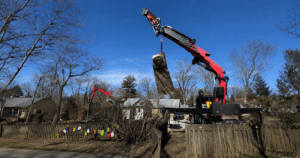
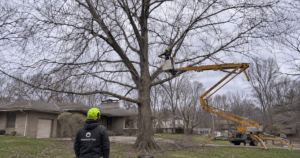
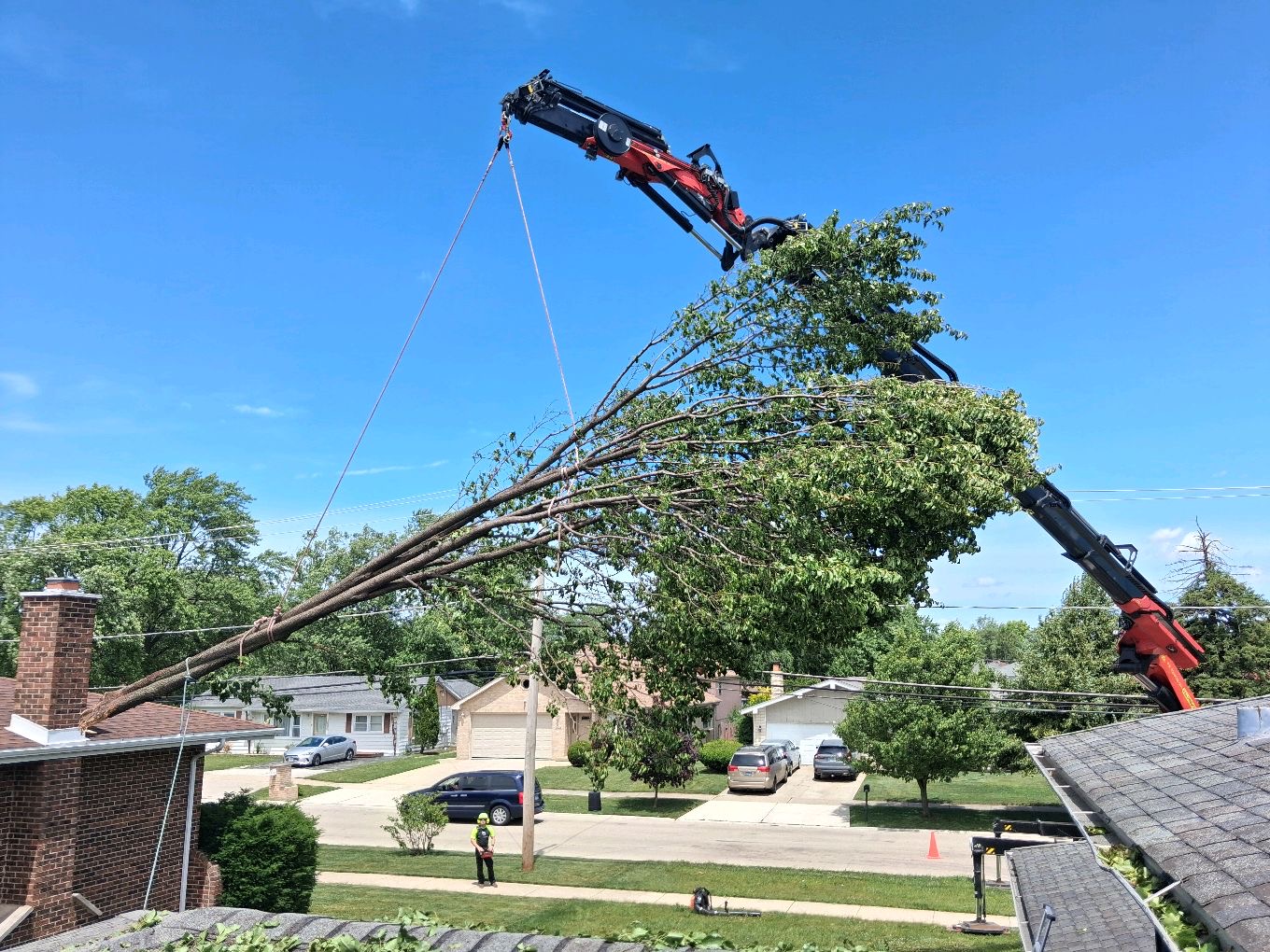
- Plan the work carefully. Rigging, property protection, and full cleanup make an enormous difference in how the day feels. A careful tree removal leaves a tidy yard, not a wrecked one.
- Decide what happens to the wood. Removed trees do not have to become landfill. Logs can be milled, kept as firewood, or processed into organic mulch that goes back into your own beds. Knowing the tree gets reused changes the emotional math considerably.
- Replant with intention. Grind the stump, amend the soil, and put something better-adapted in the gap. The open space is the opportunity, not the loss.
What Bloomington’s Canopy Is Actually Up Against
The local pressure is real and well documented. Emerald ash borer was confirmed in Indiana in 2004 and has since been detected in all 92 counties, according to the Indiana DNR Division of Entomology and Plant Pathology. Untreated ash trees in Monroe County are not a maybe — they are a timeline.
Silver maple is the other recurring story. It was planted heavily in South Central Indiana subdivisions decades ago because it grows fast, and it is now aging into the part of its life where fast growth becomes a liability: included bark at major unions, brittle wood, and limbs that come apart in summer storms. Many of the trees we look at are not diseased at all. They are simply large, old, and built out of soft wood.
Addressing declining trees on your own schedule, rather than after a storm forces the issue, is what keeps a neighborhood canopy healthy over the long run.
Replacing What You Take Out
A removal followed by a thoughtful replanting usually leaves a property in better shape than it started. Look for species suited to Monroe County soils and rainfall, with pest resistance and comparable benefits — shade, fall color, wildlife value. Local nurseries and the International Society of Arboriculture’s consumer resources are good starting points for selection.
Give the new tree a real chance: correct planting depth, proper mulching without volcano-mulching the trunk, and consistent water for the first two growing seasons. A well-placed young tree can close a canopy gap faster than most people expect.
Frequently Asked Questions
Is it wrong to cut down a sick tree?
No. When a tree is structurally unsound or too far into decline to recover, removal is the responsible option — it protects people and property and can reduce risk to surrounding trees. What matters is that the decision is based on an assessment rather than a guess.
Can a diseased tree be saved?
Sometimes. It depends on the pathogen or pest, how much live canopy remains, and how much structural wood is still sound. Early-stage problems often respond to treatment and pruning; advanced decay generally does not.
How do I know if my ash tree has emerald ash borer?
Common signs include dieback starting in the upper third of the canopy, D-shaped exit holes in the bark, S-shaped tunnels underneath it, vertical bark splits, heavy woodpecker activity, and sprouts coming from the base of the trunk. Any combination of these warrants an inspection.
Should I remove the stump too?
Usually yes, if you plan to replant or mow the area. Stump grinding removes the trip hazard, eliminates a decay site that can attract pests, and lets you restore the spot properly.
What if the tree is an immediate hazard?
If a tree or large limb is leaning over a structure, has visibly shifted, or came down in a storm, treat it as urgent and call for emergency tree service rather than waiting for a scheduled appointment.
Moving Forward With Confidence
It is okay to feel bad about losing a tree. That feeling is a sign you have been paying attention to your property, and homeowners who care about their trees are the ones who catch problems early. But responsible care sometimes means making a call you would rather not make — and making it before the weather makes it for you.
If you are looking at a declining tree and going back and forth on it, start with an assessment instead of a decision. Bluestone Tree provides on-site evaluations across Bloomington, Ellettsville, Bedford, Martinsville, and South Central Indiana, with honest recommendations about what can be saved and what cannot. If removal is the answer, we handle it carefully and clean up completely. If it isn’t, we will tell you that too.
Call 812.824.3335 or request a free estimate to schedule a consultation.
This article is for educational purposes. Every tree and site is different, and an on-site assessment by a qualified arborist is the most reliable way to determine the right course of action.