Trees do a lot of quiet work in Bloomington — they shade backyards through humid summers, buffer wind and noise, and add real value to a property. But most homeowners don’t think much about their trees until something goes wrong: a branch comes down in a storm, a trunk starts leaning, or an ash tree suddenly declines. That’s exactly what a tree risk assessment Bloomington homeowners can trust looks like — and it doesn’t have to start with a phone call to an arborist. It starts with a few honest questions you ask yourself first.
Southern Indiana’s mix of severe summer storms and ongoing pest pressure (like Emerald Ash Borer) means small issues can turn into expensive emergencies if they go unnoticed. The good news: a little self-reflection before you pick up the phone can save you money, prevent disputes with neighbors, and help you walk into any conversation with a tree service already knowing what matters most to you.
Why Thinking It Through First Actually Matters
Skipping this step tends to backfire in predictable ways. For example, a tree near power lines or your roofline can look perfectly stable — until a windstorm proves otherwise. Similarly, assuming a tree is “the neighbor’s problem” can spark a dispute that outlasts the tree itself. And ultimately, homeowners who haven’t thought about their budget or goals ahead of time often end up either overspending on unnecessary work or settling for a quick fix that fails a season later.
Additionally, in a market where curb appeal matters, neglected trees can quietly work against your home’s value, while a well-maintained tree adds to it. In short, taking ten minutes to think through the questions below turns a reactive, stressful decision into a confident, informed one.
12 Questions for a Tree Risk Assessment Bloomington Homeowners Can Do Themselves
Work through these categories in order. By the end, you’ll have a clear picture of your tree’s condition, your priorities, and your budget — which makes any conversation with a professional faster and more useful.
Location & Risk Assessment
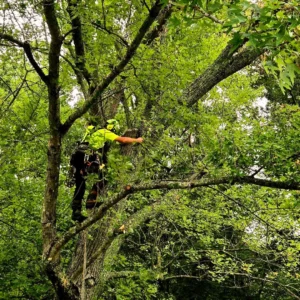
Signs of tree risk homeowners should watch for in Bloomington
- Where exactly is the tree located? Note its distance from power lines, your home, a garage, driveway, or a property line. Trees overhanging structures or utility lines usually mean more careful — and more costly — work.
- Does the tree show signs of an immediate safety risk? Look for a noticeable lean, large dead limbs (sometimes called “widow-makers”), visible cracks in the trunk, or roots that appear to be lifting or damaging a foundation. A post-storm walk-around is a smart habit in southern Indiana.
- How close is it to neighboring properties? Consider what could happen to an adjacent home, fence, or shared utility line if a limb or the whole tree came down — it’s easier to plan for this now than to resolve it after the fact.
Ownership & Legal Considerations
- Who owns the tree? If the trunk base sits on or near a property line, talk to your neighbor and confirm ownership before any work begins.
- Are there local regulations or permits to consider? Some municipalities and historic districts have rules about tree removal or trimming. Check with your local building or planning office if you’re unsure — requirements vary and are worth confirming directly rather than assuming.
Goals & Desired Outcomes
- What’s my actual goal for this tree? Are you trying to preserve a healthy, valuable tree; manage its size and shape with pruning; or remove a hazard entirely?
- Do I want a long-term health plan or a one-time fix? Specimen trees or ones with sentimental value are often worth an ongoing care plan rather than a single visit.
- How important is this tree to my landscape and privacy? It’s fair to weigh emotional attachment against practical safety and upkeep — just be honest with yourself about which one is driving the decision.
Practical & Financial Realities
- What’s my realistic budget? Larger or higher-risk removals — especially trees over 60 feet — generally cost more. Factor in stump grinding, debris cleanup, and any replanting you might want.
- Do I want to keep any of the wood? Decide ahead of time if you’d like logs kept for firewood, mulch, or milling, versus having everything hauled away and recycled.
- Am I prepared for the timeline and disruption? Depending on the scope, tree work can take anywhere from a few hours to a couple of days. Plan around family schedules or upcoming outdoor events.
- When was the last time a professional looked at this tree? If it’s been over a year — or never — especially after a storm, it’s a good time to schedule an evaluation.
What Answering These Questions Gets You
Working through these 12 questions gives you clarity before you ever pick up the phone. You’ll walk into a conversation with a tree service already knowing your priorities, your budget range, and your concerns — which tends to lead to more accurate quotes, fewer surprises, and a better long-term outcome for your property.
Many homeowners find, through this process, that pruning or treatment is a smarter and more affordable option than full removal. Others confirm that proactive maintenance now is what prevents a costly emergency later.
Ready for a Professional Tree Risk Assessment Bloomington Homeowners Trust?
Self-assessment is a great starting point, but it’s not a substitute for a trained eye. For general background on what a professional evaluation typically covers, the International Society of Arboriculture has helpful homeowner resources. Once you’ve thought through your goals, budget, and concerns, Bluestone Tree can walk your property with you, answer questions in plain language, and put together a clear plan — whether that means tree trimming, pruning, plant health care, or full tree removal.
Call 812-824-3335 or request a free estimate to schedule a visit. Ask yourself the right questions first — then bring in an expert to help you protect what matters most.
This article is for general informational purposes. A professional on-site evaluation is recommended for an accurate assessment of your specific trees and property.